
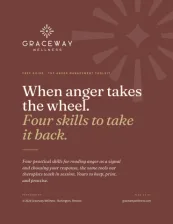
Anger Management Toolkit
4 Practical Skills for Choosing Your Response
From Graceway Wellness | gracewaywellness.com
You already know the cycle. The surge, the words you didn't mean, the quiet afterward. This anger management toolkit is about the space in between, where you still have a choice.
Anger is a normal, healthy emotion. The problem isn't anger itself, it's what happens when anger takes the wheel. The four skills below are drawn from the same approaches our therapists use in session. This is training, not soul-searching, and each skill gets stronger with practice. They apply whether the heat shows up at work, with your partner, or in the kitchen at 5pm with small kids.
1 Read the Signal
Anger is almost always secondary. The alarm is going off, but the fire is somewhere else in the house. When your reaction feels bigger than the trigger, try translating it:
Feeling disrespected shows up as anger at people who "don't listen." The real hit is to your sense of worth.
Feeling out of control shows up as anger at traffic, schedules, the small things. Underneath is powerlessness.
Feeling scared shows up as anger at a partner pulling away or vague feedback at work. Fear is hard to name, so it comes out as heat.
Feeling hurt shows up as anger at the person closest to you. The wound is softer than the reaction.
Feeling unseen shows up when you've held too much for too long and nobody noticed.
If you only treat the alarm, you'll spend your life switching it off. Read what it's pointing at and the pattern itself starts to shift.
2 Catch the Early Warnings
By the time you're shouting, the choice is already gone. The work starts earlier. Anger shows up in the body first: heat in the chest, a tightening jaw, shoulders climbing, thoughts speeding up.
- 1. Track your cues for one week. After any flare-up, note what your body did in the thirty seconds before. Two or three cues will keep repeating.
- 2. When you notice a cue, slow one exhale. Just one, longer than the inhale. You're buying seconds.
- 3. Name what's underneath, quietly. "That felt disrespectful." "I'm scared, not furious."
The gap between trigger and reaction is trainable. Even a few seconds is enough to pick a response instead of getting hijacked by a reaction.
3 The Structured Break
Storming out in silence reads as punishment. Staying past your limit guarantees words you'll regret. There is a third option, and it has rules.
- 1. Name it out loud: "I'm too heated to do this well. I need twenty minutes."
- 2. Commit to coming back. Say when, and keep your word.
- 3. Do something physical. Walk, cold water, movement. Don't rehearse the argument.
- 4. Return and re-engage. Come back to the conversation, not just the room.
A break is not a lid. Pressure that gets pushed down comes out later as sarcasm or withdrawal. The break creates space to respond, it doesn't replace the conversation.
4 Repair After the Blow-Up
While you're building these skills, some moments will still get away from you. What you do next matters as much as prevention. Repair is a skill too.
- 1. Own it plainly: "I yelled. I was overwhelmed. It wasn't your fault." No "but."
- 2. Say what you'll do differently. One concrete thing.
- 3. Check your compass. What kind of partner, parent, or colleague do you want to be? Values turn anger into data, not orders.
The people close to you don't need you to be perfect. They need to see you come back, take responsibility, and keep working at it.
When Self-Help Isn't Enough
These skills can genuinely shift everyday anger, but some patterns suggest it's time to work with a therapist:
- • Every emotion comes out as anger. Stressed, tired, scared, hurt, all of it routes through the same channel
- • The reaction doesn't fit the trigger. Spilled milk feels like an attack
- • People around you are managing your moods. A partner chooses words carefully, kids go quiet when you walk in
- • The aftermath cycle is familiar. Surge, regret, shame, repeat
None of these mean something is wrong with you. They mean the anger has roots worth understanding, and most clients see meaningful progress within 8 to 12 sessions. If you're ever worried you might hurt yourself or someone else, call or text 9-8-8 any time, or call ConnexOntario at 1-866-531-2600.
Want this as a companion email series?
3 short emails over 7 days with the Anger Management Toolkit as a PDF, plus extra tools. Unsubscribe anytime.
Explore Further
Ready to go deeper than a printout?
This toolkit is a start. If anger is costing you relationships, sleep, or the version of yourself you want to be, our anger management therapy builds these skills with a therapist in your corner. If the heat shows up inside your relationship, couples counselling may be the better starting point. And for more on the thinking behind this toolkit, read anger as a signal or, for the parenting version of this terrain, mom rage and what's underneath it.
Anger Management TherapyIt Takes Strength to Work on This
You've taken your anger seriously enough to learn real skills, and that says something. If you want training that goes deeper, a free 15-minute consultation is the next step. No pressure, no commitment, and virtual sessions across Ontario offer complete discretion.
Book a Free Consultation