Key Takeaways
- A first sandtray therapy session in Burlington is about 60 minutes, split between welcome, the tray itself, and reflection. You set the pace.
- You do not need to be artistic, symbolic, or emotionally “ready.” Curiosity is enough.
- Sandtray is only offered in-person at our Burlington office because the sand, figures, and room are part of the work.
- Our therapists witness without interpreting, so insight belongs to you.
- The shifts often show up hours or days later, quieter than you expect.
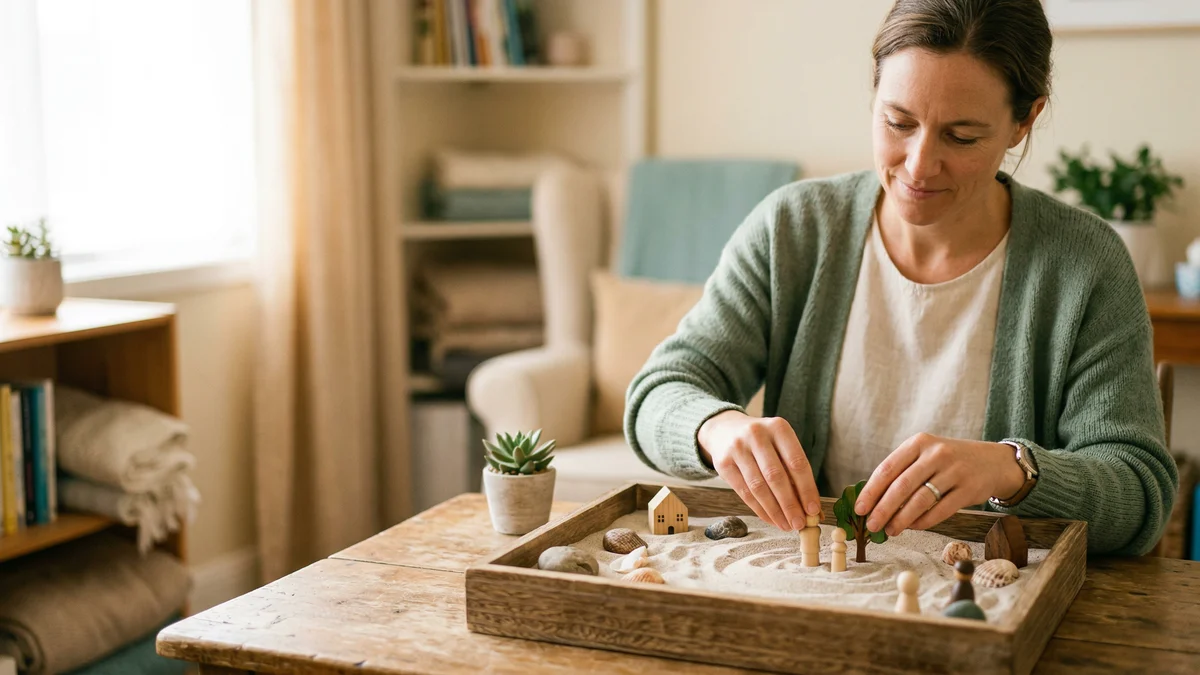
A first sandtray therapy session Burlington adults book with us usually starts not with a question, but with a breath. You walk into a quiet room, you notice a tray of sand and shelves of small figures, and something in your shoulders drops half an inch. That is by design.
If you have been circling the idea of trying sandtray and you want to know what actually happens before you commit, this walk-through is for you.
What the Room Itself Is Like
Our sandtray room at the Burlington office is small on purpose. Soft lamp light, a rug, a chair where you can sit and watch if you want, and a wooden tray filled with fine pale sand at standing height. You will not see clinical posters or anything resembling a child’s playroom, and there is no desk sitting between you and our therapist.
The shelves hold a few hundred small figures. People, trees, bridges, rocks. A lone bird. A closed door. A candle. You do not need to understand why any of them are there. Most people do not when they start.
Settling in takes a few minutes. Coat off, water poured, quick check-in about how you got here today.
How a First Sandtray Therapy Session Actually Begins
Our therapist will explain, in plain language, that there is no right way to do this. Then they will invite you to walk over to the shelves and pick whatever catches your eye.
That first moment is usually the most self-conscious one. People often say something like, “I have no idea what I am doing.” That is fine. You reach for a figure because it feels like the right one, or because it does not, or because you are not sure. All of those count.
You bring it to the tray. You place it in the sand. That is the start.
The Middle: Creating Without Explaining
For the next twenty to thirty minutes, the shape of the session changes. Your hands take over a bit. Your thinking mind quiets down.
You might:
- Move figures around more than once until something feels settled
- Notice a feeling rise up that you were not expecting
- Pause, step back, and just look
- Find yourself placing something and only later realise what it might mean
- Say very little, or nothing at all
Our therapist stays in the room but steps back physically and emotionally. They are not watching you for signs. They are holding the space so you can let your guard down inside it.
For some adults, this is the first time in years that no one has been asking them to explain themselves. That alone is worth the drive from Oakville or Hamilton.
What Happens After the Scene Is Finished
You will know when it feels done. Some people say it clicks. Others just run out of figures they want to add. There is no signal you need to give.
Our therapist will invite you to look at what you made, and to say whatever comes up, if anything. You can:
- Sit with it in silence
- Point to one part and talk about that
- Name what you see without interpreting it
- Wonder out loud
- Ask a question
If nothing comes, nothing is forced. Sometimes the scene speaks for itself, and putting words on it too quickly gets in the way. Some people take a photo to sit with during the week. Others prefer to smooth the sand flat at the end, letting the scene go.
How People Tend to Feel Walking Out
The end of a first session is usually quieter than people expect. Not dramatic. Not cathartic in the movie sense. Just a little more settled, or a little more tender, or a little more curious about something they had not been able to name.
Some common words after a first session:
- Grounded
- Surprised
- Lighter, without being able to say why
- Tired, in a good way
- Thoughtful
The bigger shifts often arrive later. Sometimes on the drive home, sometimes a few days in, when a song or a conversation lands differently than it would have last week. That delay is part of how sandtray works, and we will track it together in the next session.
If faith is part of your life, the same process can hold Christian themes and scripture without strain. We follow your lead on this. Our Christian counselling in Burlington article goes deeper into how faith and therapy work together in our practice.
Why This Has to Be In-Person in Burlington
Sandtray is one of the few things we do not offer virtually. The sand, the shelves, the physical act of walking a figure from your hand to the tray, none of that translates through a screen. It has to be felt in the room.
That is why adults drive in from Oakville, Milton, Hamilton, and Mississauga for sandtray therapy at our Burlington office. If you want to explore this modality, the trip is part of the work.
For everything else, including individual talk therapy and couples counselling, we offer virtual sessions across Ontario.
Frequently Asked Questions
How long is a first sandtray therapy session?
Your first sandtray therapy session runs about 60 minutes. Roughly 10 minutes to settle in and talk, 25 to 30 minutes with the tray, and the rest for reflection and next steps. You will not be rushed, and if something feels unfinished at the end of the hour, we will name that together.
Do I have to talk while I am creating the scene?
No. Many adults go quiet once they start placing figures, and that quiet is welcomed. Our therapist stays present without interpreting or prompting you. Words come after, or later in the week, or sometimes not in words at all.
What if I feel silly or self-conscious at the start?
That is one of the most common feelings people report, and it usually passes within the first few minutes of touching the sand. You do not need to be artistic or symbolic. The process works even when you feel awkward walking in.
Is the first sandtray therapy session in Burlington different from virtual therapy?
Yes. Sandtray is only offered in-person at our Burlington office because the sand, the figures, and the shared physical space are part of how it works. Clients travel from Oakville, Milton, Hamilton, and Mississauga for this reason.
What should I bring or wear?
Nothing specific. Wear what is comfortable. You will be standing and sitting, with your hands in sand, so short sleeves or rolled sleeves help. Everything else, including the figures and the tray, is already there waiting.
If curiosity brought you this far, a free consultation is the gentlest next step. It is a short conversation, not a commitment, to see whether our approach feels right for where you are.